Drive into Crystal River on a January morning when the air is colder than the water and you'll see the steam first — a low fog hanging over Kings Bay where 72-degree spring water meets cold gulf air. Then the backs start surfacing, slow gray curves breaking the mist. By 8 a.m. there are sometimes four hundred manatees packed into the warmer water, and the boats with snorkelers in wetsuits are already idling at the edges of the sanctuary lines.
Manatees don't migrate so much as retreat. When the Gulf and the rivers drop below about 68 degrees, they pile into Florida's spring runs, which hold steady around 72 year-round. That predictability is what makes winter viewing reliable — and what makes the spring towns of the Nature Coast and Central Florida such strange, seasonal places, half sleepy and half overrun depending on the week.
This guide covers six places to see them, what each one is actually like, and where the line falls between watching wildlife and harassing it. It skips the aquarium tanks and the boat-tour-only Indian River spots in favor of sites where you can show up under your own power and see animals in something close to their winter routine.
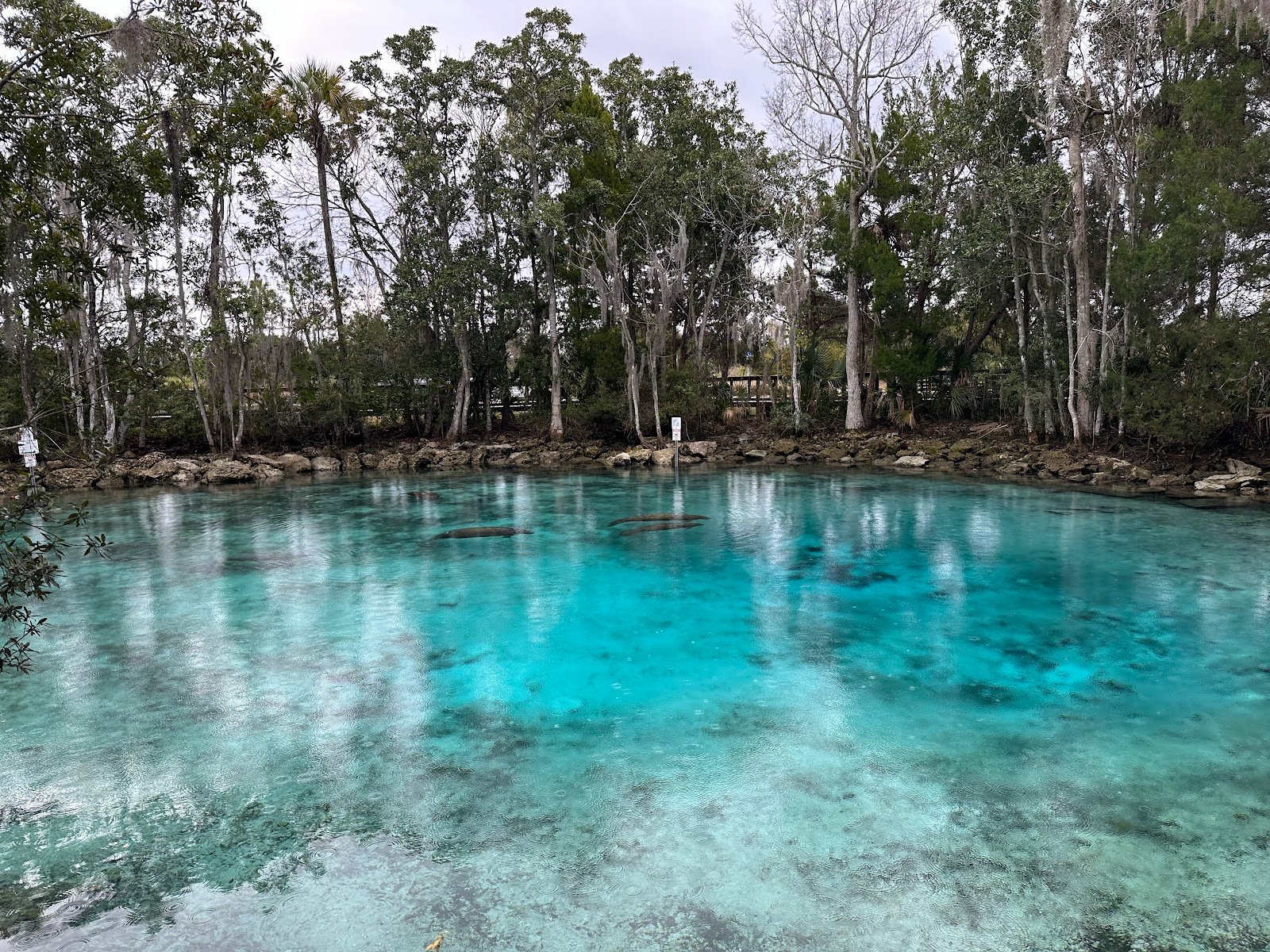
Three Sisters Springs — Crystal River
The most photographed manatee site in the state, and the one most people picture when they picture this. Three Sisters is a cluster of spring boils inside the Crystal River National Wildlife Refuge, about 90 minutes north of Tampa on the Nature Coast. In winter the springs are roped off as a sanctuary — manatees inside, humans outside the line — but the line itself is the water, and snorkelers in the connecting run can drift along the boundary while animals swim past on their way in and out.
You can access the springs two ways: by boat or snorkeler from the river side (most of the operators in town offer guided tours and rent wetsuits), or on foot via the boardwalk inside the refuge, which you reach by shuttle from a downtown trailhead. The shuttle runs a small per-person fee, parking downtown is metered, and the boardwalk view is genuinely good — calm water, daylight, no fogged mask. Peak season runs mid-November through late February. Crystal River is the only place in Florida where in-water interaction with manatees is legal, and that fact draws crowds that the small town visibly buckles under on holiday weekends.
Blue Spring State Park — Orange City
The east-coast counterpoint to Crystal River, about 40 minutes north of Orlando. Blue Spring is a single deep run flowing into the St. Johns River, and on cold mornings the entire run fills with manatees — three, four, sometimes more than seven hundred animals. No swimming with them is allowed during manatee season; the run closes to all in-water activity from mid-November through mid-March. You watch from a long boardwalk that follows the spring back to the boil.
This is, in my opinion, the best place in Florida to see manatees if you only want to see them. The water is clear, the boardwalk gets you above them at distances of a few feet, and the density on a cold January morning is genuinely surreal. Arrive at gate opening — the park caps daily attendance and routinely closes by mid-morning on cold weekends. There's a per-vehicle entry fee and a large paved lot, but neither helps if the gates are already shut.
Manatee Springs State Park — Chiefland
About two hours north of Crystal River on the Suwannee River, and a fraction of the visitation. Manatees use the spring run intermittently rather than reliably — the population here is smaller and the river is tannic, so even when animals are present, sightings are more patient than spectacular. The trade is solitude: a long boardwalk through cypress, picnic pavilions you can actually get, and the spring itself, which is one of the prettier first-magnitude springs in the state regardless of what's swimming in it.
No in-water contact during winter. View from the boardwalk or from the river side by paddle (rentals exist nearby). Standard state-park per-vehicle fee, ample parking, no crowds outside of spring break. Treat this as a place to catch manatees as a bonus rather than a destination.
Homosassa Springs Wildlife State Park — Homosassa
A hybrid worth understanding before you visit. The park's main spring holds a population of resident manatees that cannot be released — animals injured by boats, orphaned, or otherwise non-viable in the wild — alongside seasonal wild visitors who swim in from the river. You view from an underwater observatory called the Fish Bowl, which puts you eye-level with the animals below the waterline. It is the only spot on this list where you are reliably guaranteed manatees in any month.
That guarantee is the appeal and the asterisk. The resident animals are wild in body and habituated in behavior — closer to a sanctuary than a sighting. Per-person entry fee, paved parking, a tram from the visitor center. Good for families, good for people who can't make winter timing work, and a useful primer on what you're looking at before you head 20 minutes north to Crystal River for the real thing.
TECO Manatee Viewing Center — Apollo Beach
The outlier on this list and the one I'd most happily defend. TECO's Big Bend Power Station discharges warm cooling water into a channel on Tampa Bay, and the manatees figured this out decades ago. In cold snaps the channel fills with them — sometimes hundreds — and the utility runs a free public viewing center with boardwalks, a tidal walkway, and an observation tower. No swimming, obviously; this is industrial water in a working power plant outflow.
The site is open seasonally, generally November through mid-April, closed on certain holidays, free to enter, and free to park. It is the most accessible manatee viewing in the state — wheelchair-friendly, 20 minutes from downtown Tampa, no gate cap, no shuttle, no wetsuit. It is also, philosophically, a strange experience: a thermal refuge created by accident, now load-bearing for the species' winter survival on the central Gulf coast.
Wakulla Springs — Wakulla
The Panhandle entry, about 20 minutes south of Tallahassee. Wakulla is a first-magnitude spring feeding a short, deep river that empties into the Gulf, and manatees use it in winter in smaller, less predictable numbers than the peninsula sites. Viewing is from the park's river boat tour, which runs a few times daily and costs a per-person fee on top of the standard park entry. No in-water access regardless of season.
I include it because the boat tour is genuinely a good way to see the river — alligators, anhingas, occasionally manatees — and because the historic lodge on site is one of the more interesting overnight stops in north Florida. Don't make the drive purely for manatees. Make it for the spring, and take the manatees if they're there.
How to watch them without being the problem
Manatees are federally protected, and the rules exist because of specific, documented harm — animals separated from calves, animals chased out of warm water into cold and killed by it, animals scarred by boat strikes that account for a quarter of recorded deaths. The etiquette below is not optional and not subjective.
- Passive observation only. In the one place swimming is legal — Crystal River — you float. You do not swim toward, chase, corner, ride, grab, or block the path of an animal. If a manatee approaches you, you stay still and let it pass.
- No touching, even if it nudges you. A single-hand, open-palm touch is sometimes tolerated by guides if the animal initiates, but the federal guidance is no contact. Don't be the person whose video gets a tour operator fined.
- Stay out of sanctuary areas. The roped-off zones at Three Sisters and elsewhere are not suggestions. Wardens are present and citations are real.
- No flash photography in dark spring runs. It startles animals into the open river where boats are.
- Boaters: idle speed in posted zones, and watch for snouts and swirls. Most strikes happen to people who knew the rules and weren't paying attention.
When to go
The reliable window is mid-December through late February, with January typically the densest month — the colder the preceding week, the more animals concentrate at the springs. November can be hit-or-miss depending on early cold fronts; March empties out fast once Gulf temperatures climb. Avoid the week between Christmas and New Year's at Crystal River and Blue Spring unless you genuinely enjoy parking lots, and arrive at gate opening at any state park during a cold snap. Dress for being cold and wet at the same time — even spring water at 72 degrees is bracing after twenty minutes, and the air on a January morning in north Florida can sit in the 30s. If you're snorkeling in Crystal River, book a guided trip your first time; the operators know the sanctuary lines, the etiquette, and which coves the animals are using that week, and the marginal cost over a self-rental is worth it.