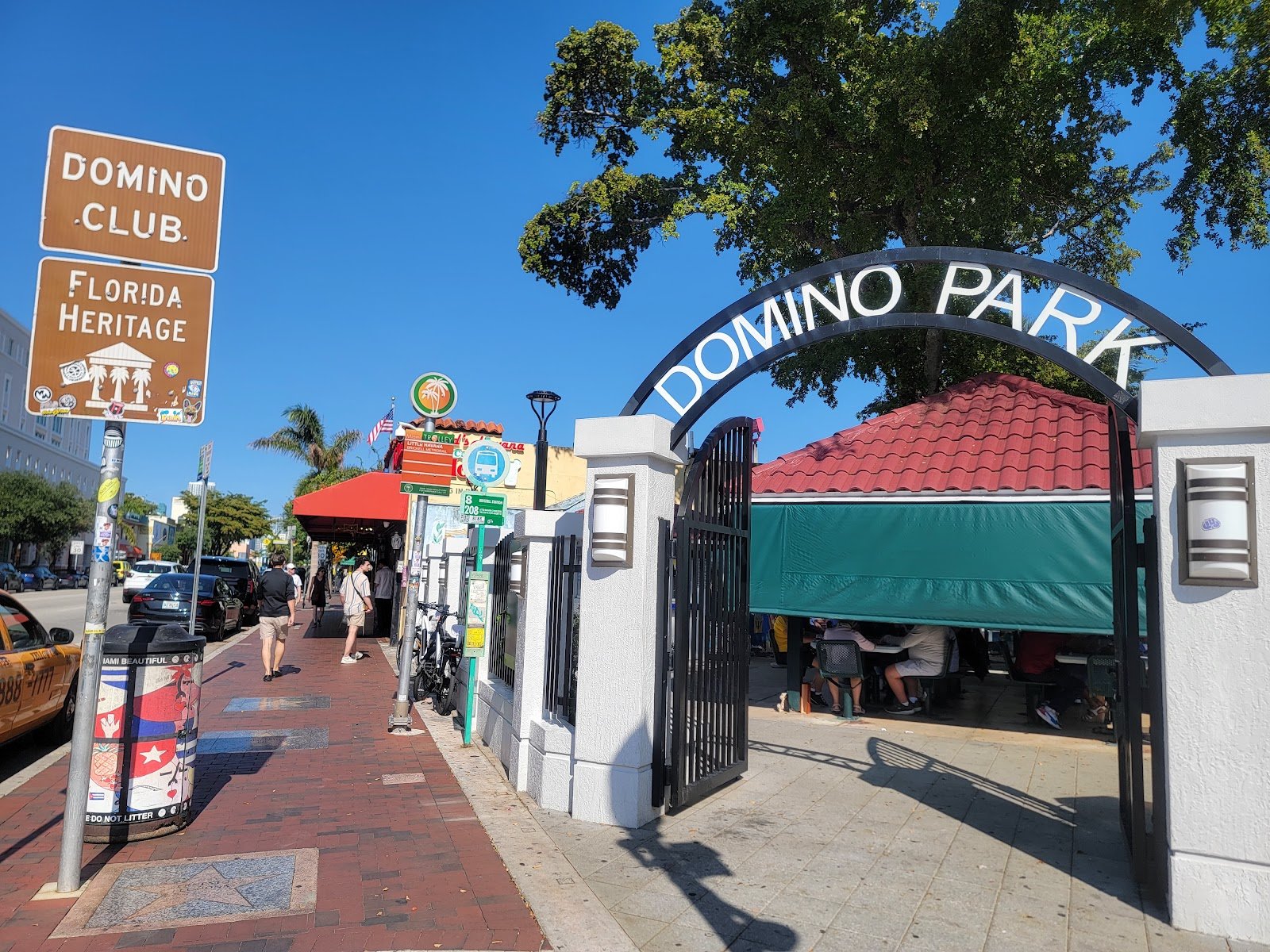
The clack of dominos on the patio at Maximo Gomez Park is the soundtrack most people remember, but the detail that tells you where you actually are is smaller: the brass-plated star on the sidewalk outside a botanica, naming an exiled Cuban actress most of Miami has never heard of. Calle Ocho's Walk of Fame runs for blocks, and almost none of its honorees are crossover famous. That is the point of Little Havana. It was built by and for a community that arrived with its own canon, its own saints, its own grammar of celebrity, and it has spent six decades refusing to translate any of it for outsiders.
What surprises first-timers is how compact and how lived-in it is. This is not a theme-park rendering of pre-Castro Havana, though there is a souvenir block that flirts with that. It is a working neighborhood of single-story homes with barred windows, third-generation family businesses, and ventanitas where the line at 7 a.m. is mostly contractors in paint-flecked boots ordering cortaditos two at a time. The tourism layer is thin and concentrated. Step one block off the main drag in any direction and you are in someone's regular Tuesday.
The lay of the land
Little Havana sits directly west of downtown Miami, with the Miami River as its rough northern edge and Coral Way feathering off to the south. The spine is Southwest 8th Street — Calle Ocho — running east-west, and the tourist-dense stretch is roughly between SW 11th Avenue and SW 17th Avenue. Cuban Memorial Boulevard, the median strip along SW 13th Avenue, is the ceremonial heart, lined with monuments to the Bay of Pigs and a ceiba tree that locals still leave offerings under.
The neighborhood took its current shape after 1959, when waves of Cuban exiles settled into what had been a Jewish and then a working-class Anglo district. Later arrivals from Nicaragua, Honduras, and other Latin American countries reshaped pockets of it — the eastern blocks have a noticeable Central American imprint — but the Cuban identity remained dominant because the institutions stayed Cuban: the radio stations, the cigar rollers, the funeral homes, the bakeries that still make pan cubano on the same ovens.
Be honest about the rough edges. Parts of Calle Ocho are scruffy, the foot traffic thins out fast after dark on weeknights, and the strip closest to I-95 has the unloved feeling of any corridor that lives off pass-through traffic. The charm is real, and so is the wear.
What to do
Maximo Gomez Park, known to everyone as Domino Park, is the obvious anchor. The tables are technically for registered seniors but the games are public spectacle, and the wall murals of Latin American leaders are worth the detour even when the patio is empty. Read the rules sign — it is unintentionally one of the funniest documents in Miami.
The Bay of Pigs Museum on SW 9th Avenue is small, volunteer-run, and run by actual veterans of Brigade 2506. It is not slick. It is also the most direct window into the political memory that shapes the neighborhood, and a half hour there explains more about Miami's voting patterns than any think piece.
Stop in at one of the working cigar factories along Calle Ocho, where rollers will let you watch them work and answer questions in whatever language you bring. Cuban Memorial Boulevard deserves a slow walk: the eternal flame, the map of Cuba carved in bronze, the plaques honoring the dead from the Brigade.
For a quieter cultural stop, the Tower Theater at 1508 SW 8th is a restored 1926 movie house that has functioned for decades as the neighborhood's de facto art-film venue. Programming has been in flux in recent years, so check what's actually showing before you build a plan around it.
Where to eat and drink
The coffee block — and it really is concentrated on a few hundred yards of Calle Ocho between SW 12th and SW 15th Avenues — is where you want to start the day. A ventanita is a sidewalk window, not a café; you order standing, you drink standing, and the cortadito is the default. Coladas come with a stack of plastic thimbles because the entire point is to share with whoever you arrived with. None of these places have indoor seating worth speaking of.
For sit-down meals, the stretch between SW 12th and SW 17th holds the old-guard Cuban dining rooms: white tablecloths, formally dressed waiters, ropa vieja and palomilla served with maduros and the kind of black beans that take six hours. Several of these rooms have been operating since the 1970s and have not updated the wallpaper, which is a feature.
The cheaper, more interesting eating is on the side streets — SW 7th Street one block north, and the cross avenues. Look for fritas at the no-frills counters, croquetas at the bakeries, and the Central American spots clustered toward the eastern end of the neighborhood for a different palette: baleadas, pupusas, tres leches done the Honduran way.
Nightlife is thinner than the daytime energy suggests. The Calle Ocho live-music venues lean toward salsa and son cubano, with cover bands of varying seriousness; the better rooms have an older clientele and a strict dress code. Cocktail bars are a recent and minor presence. For a real night out, most locals leave the neighborhood.
How to get there
Driving is the default, and parking is the friction. Street parking on Calle Ocho is metered and competitive between 11 a.m. and 4 p.m.; the side streets are residential permit zones with active enforcement, so read the signs carefully. There are a few small surface lots near Domino Park that fill by lunch on weekends. Pay attention to the painted curbs.
Ride-share is the easiest option and the drop-off culture is well established — drivers know to pull onto the side streets rather than blocking the bus lane. Public transit is workable but indirect: the Metrobus 8 runs the length of Calle Ocho, and the Brickell Metrorail station is roughly a 20-minute walk or a short ride away. There is no Metrorail stop in the neighborhood itself.
When to go
Weekday late morning is the sweet spot. The ventanitas are humming, the cigar rollers are at their tables, and you can actually hear the dominos clacking instead of competing with a tour group. Saturdays are busier and more festive but the parking situation degrades quickly. Sundays are quieter than people expect — many family-run spots close or run short hours.
The monthly anchor is Viernes Culturales, the last Friday of each month, when galleries open late, street performers set up along Calle Ocho, and the energy is closer to a block party than a tourism event. It is the single best time to visit if you are picking one. Avoid full midday in July and August — the shade is limited and the walkable stretch is exposed.
If it's your first time
Park near SW 15th Avenue and walk east on Calle Ocho. Cortadito at the first ventanita that catches you, ten minutes at Domino Park watching a game, south on SW 13th to walk the length of Cuban Memorial Boulevard, then back north and east to a cigar factory of your choice. Two hours, one block of width, and you will have seen the actual neighborhood rather than the version printed on a postcard.