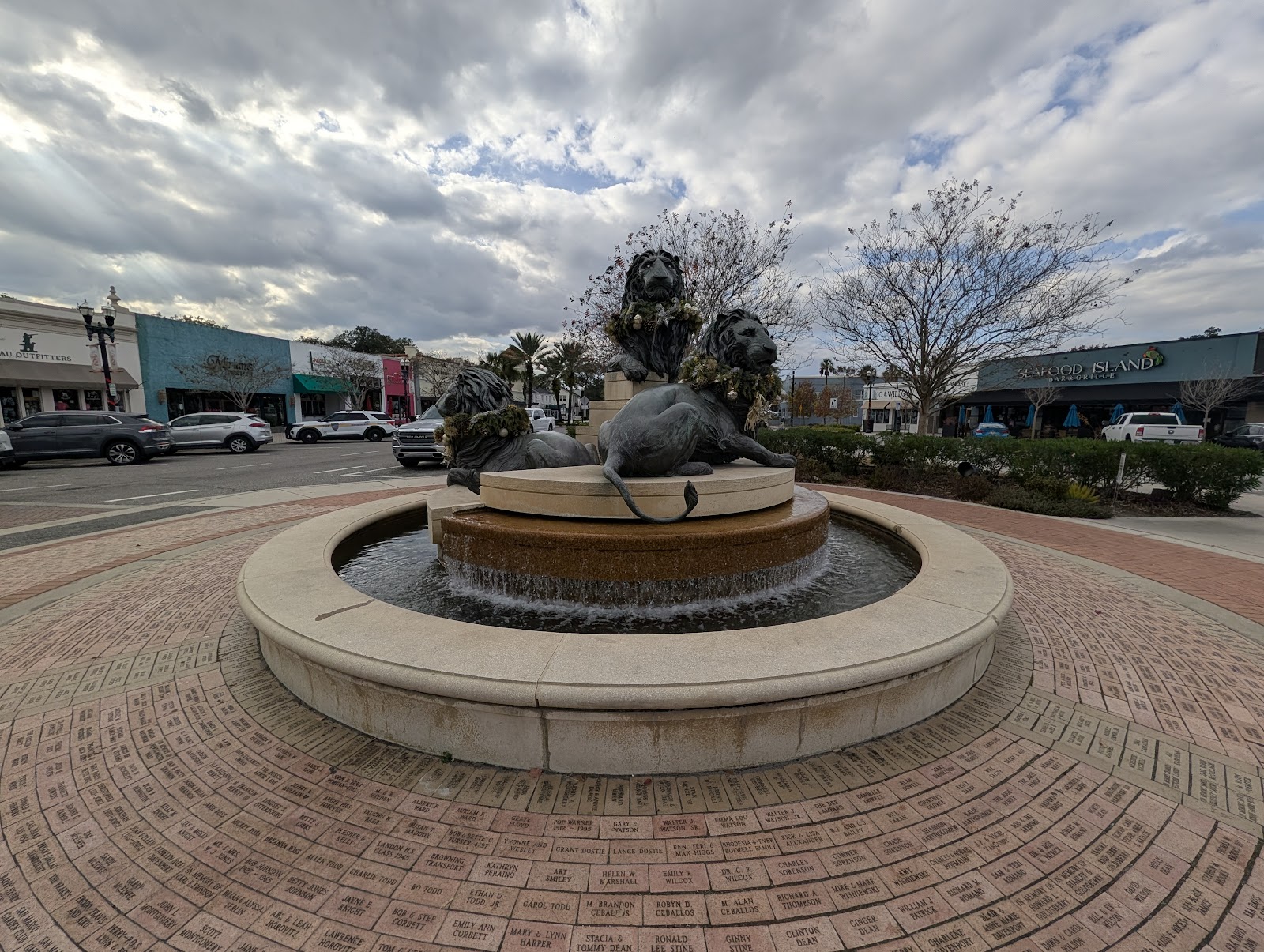
The lions don't roar. They sit, weathered green and a little uneven, at the center of a fountain that's seen nearly a century of Jacksonville weddings, prom photos, and Sunday afternoons. Cast from the same Florentine molds as their relatives in Loggia dei Lanzi, the three bronzes at San Marco Square are the closest thing this city has to a piazza icon — and the neighborhood built around them is, against the odds of postwar Florida planning, still walkable enough to actually use.
San Marco isn't downtown Jacksonville, and locals will be quick to tell you it isn't Avondale either. It sits on the south bank of the St. Johns, close enough to feel the river but tucked far enough from the freeway grid that you can hear bicycle bells over traffic. The architecture leans Mediterranean Revival and early 20th-century bungalow, the tree canopy is old, and the commercial blocks have resisted the chain-store flattening that's hollowed out so many Sun Belt neighborhoods. It's the part of Jacksonville people move to when they want to walk to dinner.
The lay of the land
San Marco proper centers on the Square — the small triangular plaza where San Marco Boulevard, Atlantic Boulevard, and Hendricks Avenue converge — and radiates out along three or four walkable blocks in each direction. The northern edge dissolves into the riverfront below the Acosta and Main Street bridges, where the Southbank Riverwalk runs west toward the museums. To the south and east, the commercial district fades into quiet residential streets of brick-paved sidewalks and live oaks.
The neighborhood was platted in the 1920s by Telfair Stockton as a planned residential community, and the developer's instinct for European-style civic space is why the Square exists at all. The bronze lions arrived in 1932, copies of Italian originals, and have anchored the district visually ever since. What's notable is how little of that original urban fabric has been lost — the storefronts are mostly the same scale they were 90 years ago.
The rough edges are real but minor. Parking on weekend nights gets tight, a few of the side streets near the Square have visible deferred maintenance, and the riverfront walkway has stretches where lighting could be better after dark. None of it diminishes the daytime experience.
What to do
The Square itself. The lions, the fountain, the surrounding arcade of shops — this is the obligatory first stop, and it earns the obligation. Sit on a bench for fifteen minutes and watch the neighborhood use the space the way it was designed to be used.
The Cummer Museum of Art and Gardens. A short drive or a long walk across the river to the Riverside side, the Cummer's formal gardens descending to the St. Johns are among the most quietly beautiful spots in the city. The collection is strong on European decorative arts and early Florida painters.
The Southbank Riverwalk. Pick it up at the foot of the neighborhood and walk west under the bridges toward the Museum of Science and History. The Acosta Bridge's underside is louder and more sculptural than you'd expect, and the skyline view across the river is the postcard one.
Balis Park and the residential loop. A few blocks east of the Square, the small green at Balis Park is a good orientation point for walking the residential streets — the Mediterranean Revival houses on the side streets are worth a slow pass on foot, especially in the late-afternoon light.
The independent bookshops and home-goods stores along San Marco Boulevard. The blocks immediately south of the Square still support genuine independent retail, which is rarer in Jacksonville than it should be.
Where to eat and drink
The food scene clusters tightly. The blocks immediately around the Square — particularly the stretch of San Marco Boulevard running south from the lions — are where the long-running supper clubs and white-tablecloth rooms sit. Several have been operating in the neighborhood since before World War II, and the dining-room style is older Jacksonville: leather banquettes, martini lists, steaks and Gulf seafood. This is the part of San Marco that locals book for anniversaries.
For coffee and casual daytime food, work the side streets just off the Square and the western end of Hendricks Avenue. The cafes here open early, lean independent, and tend to share customers with the bookstores next door. Bakeries and breakfast spots are concentrated in the same few blocks.
Drinking after dark is more dispersed. A handful of cocktail bars and wine rooms are tucked into the older commercial buildings along San Marco Boulevard, and the neighborhood has slowly grown a small craft-beer presence on the residential-edge blocks closer to Atlantic. It's not a late-night district — most kitchens close by ten on weeknights, eleven on weekends — and that's part of the appeal.
How to get there
Driving is the default, and most visitors will park in one of the small lots tucked behind the Square or in the metered street spots radiating out from it. Weekend evenings get genuinely difficult between 7 and 9 p.m. — circling for ten minutes is normal, and you're better off parking three blocks out and walking in.
JTA bus service runs along the main arteries but isn't built for short hops between districts; rideshare is faster and usually under fifteen dollars from downtown or the beaches-adjacent neighborhoods. The Skyway doesn't reach San Marco, despite the proximity. Cyclists can use the Southbank Riverwalk to connect from downtown without dealing with bridge traffic.
When to go
Saturday late morning into early afternoon is the sweet spot — the bookstores and coffee shops are open, the Square has foot traffic without being crowded, and the light on the bronze lions is at its best. Sunday brunch is the other reliable window, particularly for the supper-club rooms that do midday service.
Weeknights are quieter and good for dinner without a wait, though some of the smaller shops close by six. The neighborhood hosts periodic art and merchant walks worth checking the local calendars for. Avoid the summer afternoons between two and four — the humidity off the river is punishing, and the canopy only helps so much.
If it's your first time
Start at the lions, walk one block south down San Marco Boulevard browsing the shops, cut east at Atlantic to circle through the residential streets around Balis Park, then loop back to the Square for a drink or dinner. Two hours, almost no driving, and you'll have seen what makes the neighborhood worth the trip.