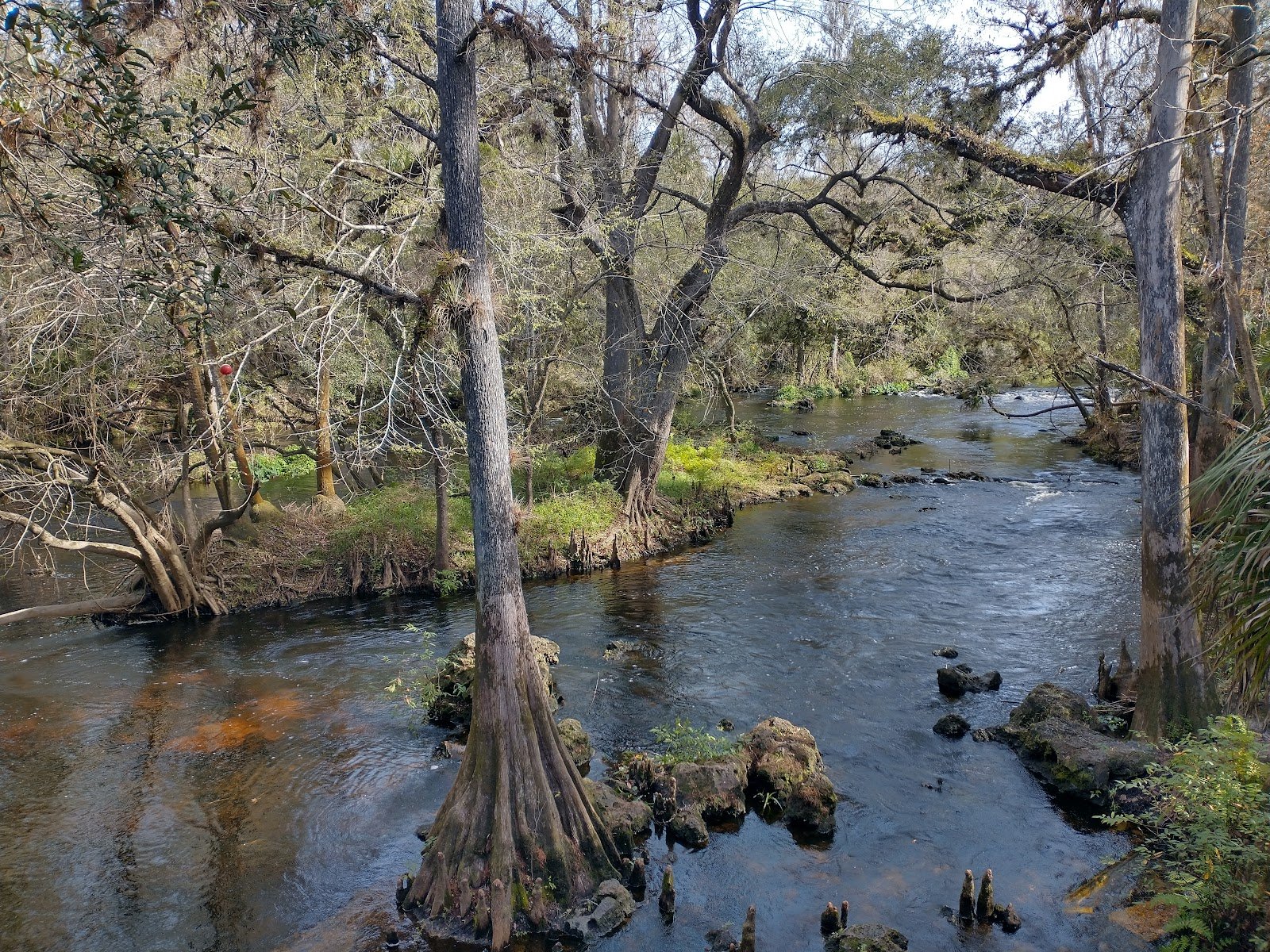
Florida has 175 state parks, and a good number of them are better than the national parks people fly across the country to see. The catch is that nothing about the state's geography reads as obvious from a map. A first-time visitor lands in Orlando expecting beaches, drives an hour, and ends up in a longleaf pine savanna with red-cockaded woodpeckers overhead. Another flies into Miami for the Keys and discovers that the most interesting reef in the continental U.S. sits inside a state park, not a national one. The ecosystems shift every two hours of driving, and the parks are where those shifts become legible.
What follows is not a ranking of the prettiest parks, or the most Instagrammed, or the ones with the best campsites. It is a starter kit. Seven parks, one from each of Florida's distinct regions, chosen because each one introduces a different landscape you cannot easily see elsewhere in the country: first-magnitude springs, living coral reefs, tropical hardwood hammocks, Gulf barrier dunes, Atlantic coquina shoreline, cypress swamp, and subtropical pine rockland. Visit all seven and you will understand Florida better than most people who live here. Visit two or three and you will understand why the residents who actually go outside tend to be evangelists for the park system rather than the theme parks.
Grayton Beach State Park (Panhandle)
Nearest city: Destin, about 30 minutes east along 30A. What makes it distinct: The Panhandle's sand is the whitest in Florida — pure quartz washed down from the Appalachians over millennia — and Grayton preserves a long stretch of it backed by a coastal dune lake, a landform that exists in only a handful of places worldwide. The lake periodically breaches through to the Gulf, creating a brackish channel that shifts month to month. What to do: Paddle Western Lake in a rented kayak, then walk the dune crossover to the beach for the contrast between tannin-dark freshwater and turquoise saltwater within a hundred yards. Entry fee: Around $5 per vehicle. Best time: Late April through May, before the Gulf Coast humidity sets in and before the summer beach crowds peak.
Ichetucknee Springs State Park (North Florida)
Nearest city: Gainesville, about 45 minutes northwest. What makes it distinct: Florida sits atop one of the largest concentrations of first-magnitude springs on the planet, and the Ichetucknee is the clearest entry point to that world. Eight named springs feed a six-mile river that runs a constant 72 degrees and clear enough to read a paperback through ten feet of water. What to do: Float the river on a tube from the north entrance — a slow, three-hour drift past cypress knees, swimming turtles, and the occasional otter. The tube concession runs seasonally, roughly Memorial Day through Labor Day. Entry fee: Around $6 per vehicle, with separate tube launch fees. Best time: A weekday in early June, before school is fully out and before the summer crowd discovers the daily tube limit fills by 10 a.m.
Wekiwa Springs State Park (Central Florida)
Nearest city: Orlando, about 30 minutes north. What makes it distinct: The fact that one of the state's better springs sits inside the Orlando metro is the punchline. Wekiwa is where Central Florida residents learn that the alternative to theme parks is twenty minutes away and costs the price of a coffee. The headspring forms a swimming basin, and a wild, blackwater run feeds north into the Wekiva River system, home to alligators, manatees in cooler months, and one of the better river paddles in the state. What to do: Rent a canoe at the park concession and paddle two hours upstream toward Rock Springs Run — turn around when your arms get tired, and the current does the return trip for you. Entry fee: Around $6 per vehicle. Best time: March and October, when air temperatures match the spring temperature and the swimming hole has not yet flipped to capacity-limit mode.
Honeymoon Island State Park (Gulf Coast)
Nearest city: Tampa-St. Pete, about 40 minutes northwest via Dunedin. What makes it distinct: Most of the developed Gulf Coast has been seawalled, dredged, or replenished into a smooth approximation of a beach. Honeymoon, a barrier island accessed by a single causeway, preserves what the rest of Pinellas County used to look like — virgin slash pine, osprey nests every few hundred yards, and a four-mile beach where the only structures are a snack bar and restrooms. The northern tip looks across to Caladesi, accessible by ferry. What to do: Walk the Osprey Trail through the pine flatwoods, then ride the ferry across to Caladesi for a half-day on a beach you can only reach by boat. Entry fee: Around $8 per vehicle. Best time: February or March, when the Gulf is too cold for casual swimming but warm enough to wade, and the snowbird crowd thins on weekdays.
Anastasia State Park (Atlantic Coast)
Nearest city: St. Augustine, with the park entrance about ten minutes from the historic district. What makes it distinct: The Atlantic side of Florida sits on coquina — a soft sedimentary rock made of compressed shell fragments — and the historic city next door was literally built from it. Anastasia preserves the dune ridge and tidal lagoon that produce the stuff, plus four miles of broad, hard-packed beach that runs darker and flatter than the Gulf's quartz sand. What to do: Walk the beach at low tide from the main crossover north toward the inlet, where the shell pile-ups are dense enough that you can spot small whelks, olive shells, and the occasional shark tooth without much effort. Entry fee: Around $8 per vehicle. Best time: November and early December, when the Atlantic stops being aggressive, the wind drops, and the city next door turns on its holiday lights.
Highlands Hammock State Park (South Florida — interior)
Nearest city: Sebring, in the agricultural interior between Orlando and Lake Okeechobee. What makes it distinct: The Florida that exists below the I-4 corridor and above the Everglades is mostly invisible to visitors, and Highlands Hammock is the best argument for stopping there. It is one of the original four state parks, established in the 1930s, and preserves a virgin hardwood hammock with thousand-year-old live oaks, sabal palms, and a cypress swamp boardwalk where alligators sun themselves a few feet from the railing. What to do: Take the ranger-led tram tour through sections of the park you cannot reach on foot — it runs roughly daily in winter and is the rare guided experience worth the seat. Entry fee: Around $6 per vehicle. Best time: January and February, when the mosquitoes retreat and the swamp boardwalk becomes pleasant rather than punishing.
John Pennekamp Coral Reef State Park (Keys)
Nearest city: Key Largo, the first Key south from the mainland. What makes it distinct: Pennekamp was the first undersea park in the United States, and it protects a portion of the only living coral reef tract in the continental country. The reef sits several miles offshore, which means the park is mostly water — the land portion is small, but the boat concession is the point. What to do: Book a half-day snorkel trip on the park's own concession boats rather than driving farther south. The captains know which reefs are clearest that morning, and the trip costs roughly what an Orlando theme park lunch does. Entry fee: Around $9 per vehicle, with snorkel trips priced separately. Best time: Late April through early June, when visibility on the reef peaks and hurricane season has not yet arrived.
When to go
The honest window for a first Florida park trip is late October through early May, and within that, the sweet spots are November and March — warm enough for water, cool enough for trails, and free of both the summer heat index and the worst of the spring break overlap. Avoid August and September unless you are committed to dawn-only hiking and afternoon thunderstorms, and avoid the week between Christmas and New Year's at any park with a swimming basin or campground, when occupancy caps fill before 9 a.m. A few etiquette notes that apply across all seven: do not feed any wildlife, do not touch the coral at Pennekamp (sunscreen residue is the larger culprit, so wear a rash guard or a reef-safe formula), give alligators a wide berth on spring runs and stay out of the water at dusk, and pack out everything you pack in. Florida's parks stay good because the people who use them treat them like the inheritance they are.