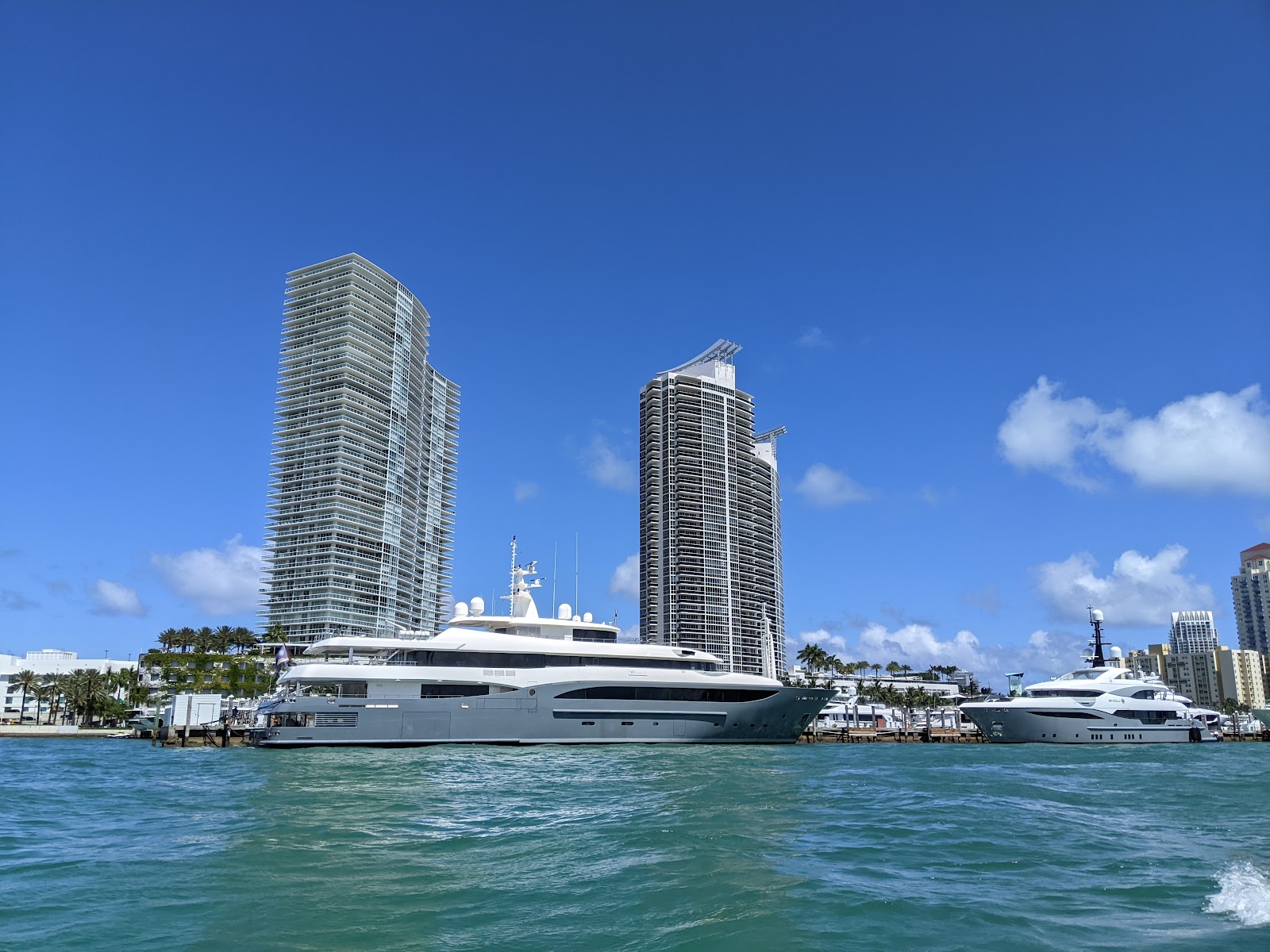
The first thing you notice in Brickell is the wind. It rolls in off Biscayne Bay, threads between the glass towers along Brickell Avenue, and turns every street corner into a small weather system. The second thing you notice is that almost no one walks with their head down. People here look up — at the silver underside of the Metromover gliding overhead, at the cantilevered balconies sixty floors up, at the cranes that never quite seem to leave the skyline. For a district built around finance, Brickell has an unusually theatrical relationship with its own architecture.
That theatricality is also what makes it misunderstood. Visitors arrive expecting a sterile office park and find instead a dense, walkable square mile where the restaurants stay full past midnight, where a Saturday morning at the bay-front parks looks like a United Nations of stroller traffic, and where the bars worth knowing about are tucked behind unmarked doors at the base of residential towers. Brickell is Miami's experiment in vertical urbanism, and it has become, almost by accident, one of the most interesting eating-and-drinking neighborhoods in the state.
The lay of the land
Brickell sits directly south of the Miami River, bounded by Biscayne Bay to the east and I-95 to the west. The spine is Brickell Avenue, which runs north-south and was once lined with mansions — the so-called Millionaire's Row of the early twentieth century. Almost none of that survived the building boom. What you see today is largely post-2000: a forest of residential and office towers anchored by the open-air Brickell City Centre development, with the older bank buildings of Brickell Key sitting on a man-made island just offshore.
The neighborhood divides itself into rough zones. North of SE 8th Street is the financial core, denser and more corporate during weekday lunch hours. South of that, toward the Roads neighborhood, it softens into longer blocks, tree-lined sidewalks, and the bay-front condo strip. Brickell Key, reached by a single bridge at SE 8th, feels like a separate country — quieter, more residential, and ringed by a pedestrian path that locals use for sunrise runs.
The honest caveat: parts of West Brickell, particularly near the highway, still feel like construction zones, and the sidewalk experience can lurch from polished plaza to dust-and-orange-cones within a block. Plan accordingly.
What to do
Walk the Underline. The linear park beneath the Metrorail tracks now stretches from the river south through Brickell and into Coconut Grove. The Brickell stretch includes outdoor gym equipment, a butterfly garden, and a long, shaded promenade that doubles as the neighborhood's de facto greenway. It is the single best free thing to do here.
Cross over to Brickell Key. The pedestrian loop around the island is just over a mile and offers the cleanest skyline views in the city. Sunrise is the move; the light hits the downtown towers and the Port of Miami cruise ships at the same time.
Look up at the towers themselves. Brickell is an open-air gallery of contemporary high-rise architecture, from the twisted form of the residential tower at 1000 Museum (technically just over the bridge, but visible from everywhere) to the layered terraces of the newer developments along South Miami Avenue. The neighborhood rewards architecture nerds with binoculars.
Hit Simpson Park. A pocket of original Miami hardwood hammock preserved mid-tower, on South Miami Avenue. Three acres of subtropical forest with a boardwalk through the middle. It is the strangest and most disorienting thing in Brickell.
Time a sunset at the Miami Circle. The 2,000-year-old Tequesta archaeological site sits at the mouth of the river, with interpretive plaques and a small park around it. It is a useful reminder that this land had a city on it long before the bank towers arrived.
Where to eat and drink
The food scene has matured fast. The old reputation was steakhouses and hotel restaurants charging Midtown Manhattan prices for adequate food. That is no longer the whole story.
The chef-driven rooms are concentrated along South Miami Avenue between SE 8th and SE 13th — a walkable strip of independent operators in ground-floor spaces below condo towers. Expect Latin American tasting menus, modern Israeli, omakase counters, and at least two pasta rooms worth the trip. This is the block to wander on a Friday night without a reservation and see what opens up.
For coffee and weekday breakfast, the Mary Brickell Village side of the neighborhood and the smaller pockets along SE 10th Street have a cluster of independent cafés — most do third-wave coffee, light Mediterranean plates, and outdoor seating that catches the morning sun before the towers cast it into shadow.
Drinks split into two worlds. The rooftop and hotel-bar scene runs along Brickell Avenue itself, with bay views and twenty-five-dollar cocktails. The more interesting drinking happens at the alley-and-arcade level of Brickell City Centre and along the side streets just west of South Miami Avenue, where small bars — natural wine, mezcal, listening rooms — operate at a quieter volume. Look for the unmarked doors.
How to get there
The Metromover is free and the most pleasant way to enter Brickell from downtown, with stops at Eighth Street, Tenth Street, and Financial District. The Brightline station at MiamiCentral is a short Metromover ride away if you are coming from Fort Lauderdale or West Palm. From farther out, the Metrorail Brickell stop drops you directly at the Underline.
Driving is the painful part. Brickell Avenue grinds to a halt during weekday rush, and street parking is essentially nonexistent. The municipal garages at Mary Brickell Village and the City Centre are your realistic options, and both fill on weekend evenings. Ride-share is usually faster than driving yourself; ask the driver to drop you on a side street rather than the main avenue to avoid the queue.
When to go
Sunday morning is the secret. The financial-district crowd is gone, the bay-front parks are uncrowded, and brunch reservations open up. Weekday lunch is energetic but loud; weekday evenings after about 7 p.m. are when the restaurant scene actually peaks. Saturday nights along South Miami Avenue can hit Miami Beach levels of crowding, with the wait times to match.
The shoulder months — October, November, and April — give you the best weather without the high-season prices. Avoid the week of any major art fair or boat show unless you have booked everything in advance, and skip the financial-district streets entirely on weekday mornings if you are not in a hurry.
If it's your first time
Start at the Brickell City Centre Metromover stop, walk east toward the bay, cross the bridge onto Brickell Key, and loop the island for the skyline view. Come back across, head south on South Miami Avenue for an early dinner, and finish with a drink at one of the smaller rooms tucked behind the main strip. Two hours, no car, and you will understand the neighborhood.