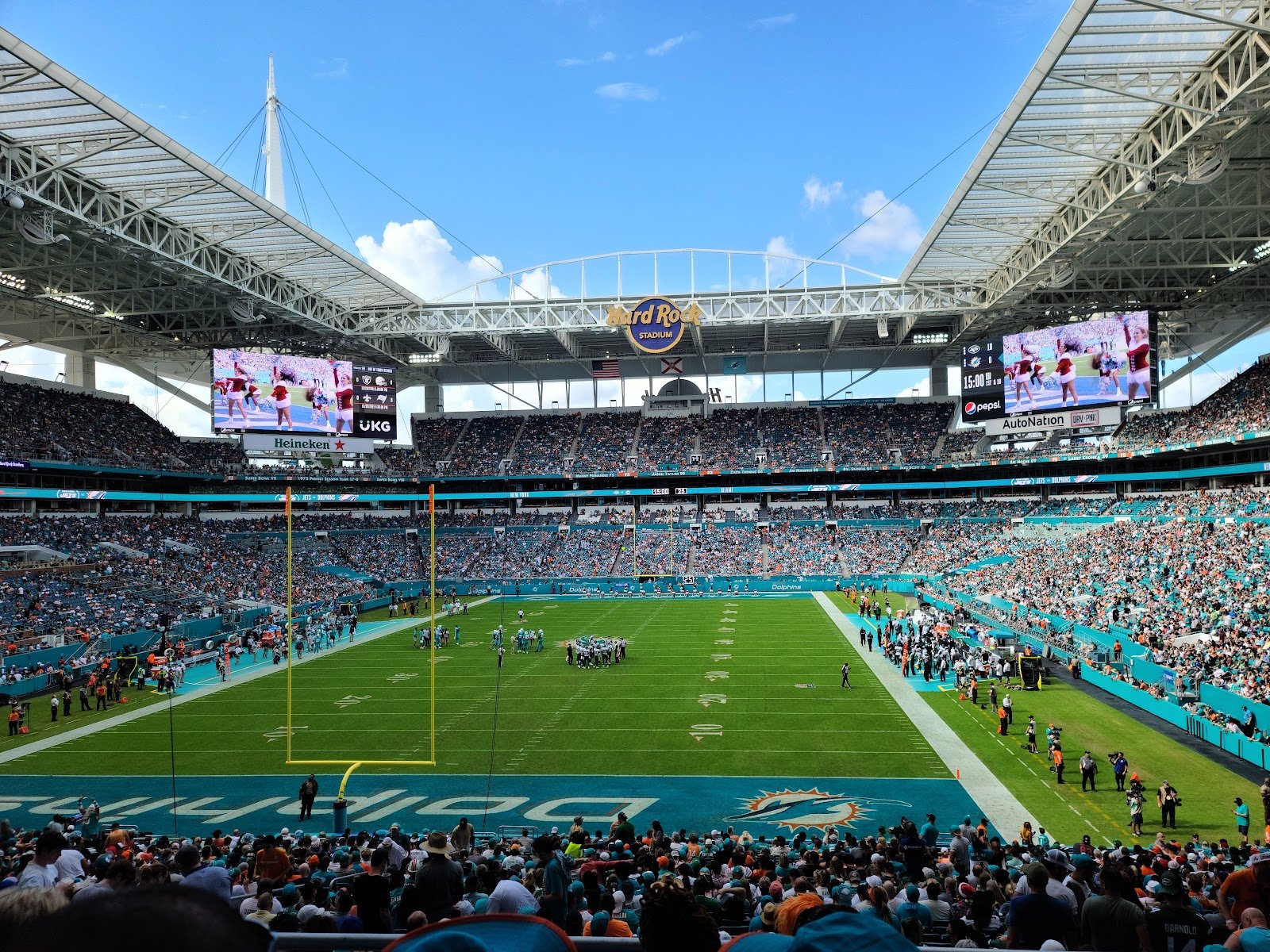
Hard Rock Stadium sits in Miami Gardens, twenty miles north of South Beach and surrounded by strip malls and logistics warehouses — a fact that still surprises anyone who assumed the name implied something oceanfront. What makes the place genuinely interesting is not the building itself but what it becomes on back-to-back days in the fall: a Hurricanes Saturday and a Dolphins Sunday drawing crowds that share a parking lot and almost nothing else in terms of temperament, timeline, or purpose.
College game days here are shaped by alumni loyalty, a Greek life infrastructure, and a particular Miami swagger the program has been working to reclaim since its dominant years. NFL Sundays feel comparatively corporate — later arrivals, more visiting-team jerseys, a crowd calibrated to broadcast windows rather than tradition. Getting inside both experiences gives you a more complete picture of how South Florida actually uses this stadium, and how much the preparation differs depending on which day of the week you show up.
This guide covers the practical differences: parking strategy on a Saturday versus a Sunday, the Smoke Show tailgate and what makes it worth your morning, where the Canes alumni actually gather, how to navigate Hurricane Way without getting caught in a crush, and where to eat after the game when Aventura and Hallandale Beach are your best options for not spending ninety minutes in post-game traffic. The information here reflects how the experience actually works rather than how the stadium's promotional materials describe it.
Lot 13 vs. Lot 27: The Parking Calculus Is Different Every Day
For a Dolphins Sunday, Lot 13 draws the corporate end of the fan base — efficient access to the club entrances, a faster exit toward the 441 corridor, and well-suited to people whose game day starts forty-five minutes before kickoff and ends at the two-minute warning. For a Canes Saturday, attention shifts to Lot 27, historically where the tailgate culture concentrates. The walk from Lot 27 to the main gates is longer, and that length works in its favor: you absorb the scene rather than executing a parking transaction.
Timing is the governing variable. Hurricanes tailgates begin four to five hours before kickoff, and the preferred lots fill accordingly. On a Dolphins Sunday, arriving ninety minutes before game time is workable. On a Canes Saturday for any matchup with genuine stakes, ninety minutes is already late for anyone expecting space in the lots that matter.
The Smoke Show: What Saturday Morning Actually Looks Like
The Smoke Show is the organized tailgate experience built around Hurricanes game days — coordinated grills, sound systems, and tents that transform the north parking area into something closer to a music festival than a standard pregame. It operates at a scale that surprises people who've only attended NFL tailgates, which tend to be looser collections of individual setups with no connective tissue. Here, the structure is communal: alumni from different graduating classes eating from the same grills, music that tracks the Miami that shaped the program during its championship years.
The Smoke Show is not a sanctioned university event in the official sense, but it is embedded deeply enough in game day culture that it functions as one. If you want to understand why South Florida college football carries a different weight than the SEC or Big Ten experience, two hours in the Smoke Show lot before kickoff is the most efficient education available.
Where the Alumni Actually Congregate Before Kickoff
Pre-game alumni activity concentrates in the northwest lots for tailgating, but for high-profile matchups the pattern extends much further south. The University of Miami campus is in Coral Gables, eighteen miles from the stadium, and many serious fans treat the Miracle Mile restaurant corridor and Coconut Grove as pre-pre-game territory before migrating north. The geographic gap between campus and stadium has always created a logistical awkwardness that the fan base has mostly solved by building an extended ritual around it.
On a Dolphins Sunday, there is no equivalent alumni geography pulling people in any particular direction. The crowd disperses from wherever fans live — Aventura, Brickell, the beach cities — and the bars that fill up tend to organize around Biscayne Boulevard rather than any institutional loyalty.
Hurricane Way: Reading the Walk Before You Enter
Hurricane Way is the pedestrian corridor that connects the outer lots to the stadium's main entry plazas. On a Canes Saturday before a significant home game, it runs dense with orange and green from two hours before kickoff through the opening quarter — people arriving late, people who've been in the lot since early morning making a slow processional toward the gates. The walk has a particular quality when the stadium is ahead of you and the sound from the tailgate lots is still carrying from behind.
The same corridor on a Dolphins Sunday is functional and unmemorable. It moves people from one place to another. Attending both within the same season makes the comparison impossible to ignore, and it reframes what each league is actually selling its audience beyond the game itself.
The Turnover Chain and the Culture That Built It
The turnover chain — a large gold chain worn by whichever Hurricanes defender forces a turnover — became a nationally recognized symbol when the program introduced it in 2017, and it has been copied by programs across the country since. Inside Hard Rock Stadium on a Saturday, a defensive turnover produces a crowd response disproportionate to the game situation in a way that professional football rarely matches. The chain is a prop, but it connects to something substantive: defensive aggression and a Miami-specific posture that the program's identity was built on during its dominant stretch.
The "It's All About The U" chant runs through the stadium at key moments and is not delivered ironically. For a significant portion of this fan base, the program is the U, and the U precedes most other considerations including, sometimes, the score on the board.
What Changes When the NFL Comes to Town
The Dolphins game day is a professionally managed entertainment product with different expectations on both sides of the transaction. The crowd skews older on average, pregame noise outside the stadium is more diffuse, and the in-stadium rhythm is shaped by broadcast windows rather than organic crowd energy. A Dolphins game against a compelling opponent in cooperative weather is an excellent afternoon — this is not a criticism of the product, only a description of it.
What the NFL day offers over the college day is operational smoothness: more consistent stadium operations, faster concession lines on average, and an exit flow calibrated to a professional timeline. What it trades away is the communal quality that makes a Canes Saturday feel like something more than a sporting event with a defined start time.
Getting Out: Post-Game Traffic Has Two Different Solutions
Post-game traffic at Hard Rock Stadium is a fixed problem regardless of day. The directional split differs: after a Dolphins game, I-95 southbound backs up as the crowd disperses toward Miami Beach, Brickell, and Wynwood; after a Canes game, traffic divides more evenly between south toward Coral Gables and north into Broward County.
The best move on either day is the same: remain inside the stadium until the first wave of the parking lot rush has thinned, use surface roads east toward Biscayne Boulevard, and treat I-95 as a last resort for at least forty-five minutes after the final whistle. If Aventura is the destination, routing via NE 167th Street into the mall corridor bypasses the highway entirely and moves faster than it appears on the map.
Aventura Mall: The Post-Game Food Court Argument
Aventura Mall sits less than four miles from Hard Rock Stadium and its food court absorbs a reliable portion of post-game overflow on both Saturdays and Sundays. The options are genuinely varied, the seating is abundant, and the air conditioning is aggressive in a way that feels earned after three hours in a South Florida open-air stadium. This is not the destination for a meaningful post-game decompression; it is the solution when the group has conflicting preferences and needs to eat quickly without committing to a reservation or a wait list.
The mall's proximity also serves a practical secondary function: it keeps you off the highway while the worst of the stadium traffic resolves itself, which makes the forty-five minutes spent eating in a food court a net positive in terms of total travel time.
Cipriani Aventura: When the Occasion Warrants a Sit-Down
For a post-game dinner that actually reflects the occasion — a rivalry win, an opener against a ranked opponent, a Dolphins game with meaningful playoff context — the higher-register options in Aventura proper offer a different register. Cipriani represents the upper end of that range: Italian-inflected, suited to larger parties with something to celebrate, and priced accordingly. The reservation situation after a major game is predictable, and walking in unannounced on a crowded post-game evening is a gamble. A call ahead resolves most of it, and if you're waiting at the bar, that particular bar is not a hardship. The proximity to the stadium without the full tourist density of South Beach makes this part of Aventura the more practical choice for a real meal after a real game day.
Hallandale Beach and the Coastal Stretch Nearby
Hallandale Beach sits roughly ten minutes northeast of Hard Rock Stadium and offers a less congested post-game alternative to Aventura's main commercial corridor. The restaurants and bars along the US-1 stretch through Hallandale serve a mixed crowd of locals and stadium overflow, and the proximity to the coast provides a useful psychological reset after a long game day. For those extending the trip further south toward the Miami Beach hotel strip — where the Eden Roc anchors the upper end of Collins Avenue — the drive is longer but appropriate if you're treating the day as a full South Florida experience rather than a strictly stadium-in, stadium-out operation. The beach corridor shifts the energy in a way that no inland restaurant, however good, can replicate.
When to Go
The optimal window for a Hurricanes home game is late September through November, after the worst of the summer heat has broken and before the season's bowl implications have collapsed the middle of the schedule into pure arithmetic. Avoid August and early September games unless the kickoff is confirmed for the evening and you've made peace with genuine heat and humidity inside an open-air venue. For Dolphins games, the same seasonal logic applies, with December games frequently offering both better weather and elevated stakes. On either day, early arrival and a patient departure are the two most underrated decisions you can make — the stadium rewards both. The Canes fan base in particular observes unwritten rules about stadium conduct: noise on defense, restraint on offense, and a general expectation that the people around you have come to watch football rather than narrate it into a phone. Respect that, and the experience works considerably better.