By mid-October, the cranes start arriving on Seventeenth Street. Flatbeds line up along SE 17th Causeway like they're waiting for a parade, and the dockmasters at Bahia Mar begin the slow choreography of staging a floating city. Locals who live along the New River know what's coming: a week when traffic on Las Olas crawls, every hotel room within ten miles is booked, and the marine industry that quietly props up a third of Broward's economy puts on its annual show.
The Fort Lauderdale International Boat Show is not subtle, and it does not pretend to be. For 2026, the show returns in its now-familiar seven-venue sprawl, with the post-pandemic shift toward bigger superyachts and a more international buyer base fully entrenched. What makes this edition worth your time is less the boats themselves — they get larger every year, predictably — and more the surrounding ecosystem: the brokers, the captains, the sailmakers, the marine electronics nerds, all in one place for five days before scattering back to Monaco and Newport.
What it is
FLIBS has run since 1959, when it was a modest local affair organized by a handful of Fort Lauderdale dealers. It is now routinely described as the largest in-water boat show in the world, a claim nobody seriously contests. Informa Markets runs it; the Marine Industries Association of South Florida benefits from it; and the city of Fort Lauderdale tolerates the disruption because the economic impact lands somewhere north of half a billion dollars.
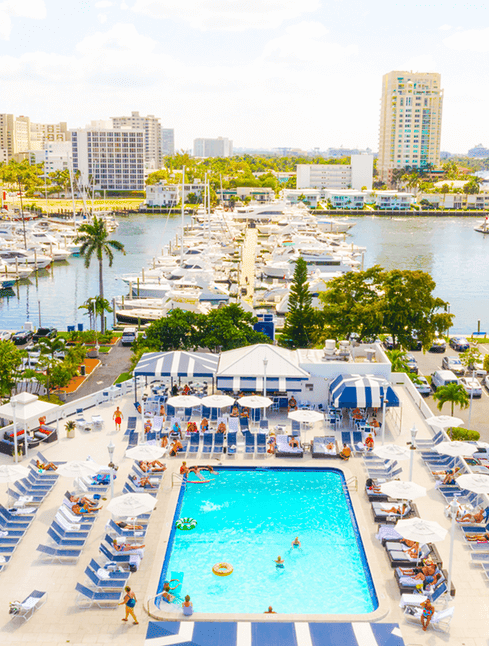
The format is seven venues stitched together by water shuttle, land shuttle, and a tolerance for walking long floating docks in the sun. Bahia Mar is the spiritual center. Pier Sixty-Six, the Hall of Fame Marina, Las Olas Marina, the Broward County Convention Center, and Sails Marina round out the official list. You will see everything from center consoles you could plausibly afford to 300-foot custom builds that exist primarily as tax structures.
The crowd is genuine industry on weekdays — brokers in polos, builders from Italy and Turkey, captains comparing notes on stabilizers — and considerably more aspirational on the weekend. The hype-to-substance ratio is honest. There is real business done here. There is also a lot of rosé.
When and where
The 2026 edition is scheduled for [late October / early November 2026, exact dates TBD], running its usual five-day window from a Wednesday preview through Sunday. Bahia Mar on A1A serves as the main entrance and the de facto hub, with shuttles radiating out across the Intracoastal. Expect the impact to spread from the beach side of Las Olas down through the Isles, with Seventeenth Street effectively turning into a one-way industry corridor for the duration.
Getting there
Driving in and parking on-site is a losing proposition unless you have a credentialed pass. The show runs official park-and-ride lots — the War Memorial Auditorium lot is the most reliable — with continuous bus service to Bahia Mar. Water taxi is the elegant option if you are staying along the New River or in the downtown corridor; it drops you closer to Pier Sixty-Six than any rideshare can get.
Rideshare zones are clearly marked but get gridlocked from about 11 a.m. onward. The trick is the designated Uber and Lyft pickup on the north side of Bahia Mar; the south-side queue is twice as long for the same cars. If you are coming from Miami, take Brightline to the Fort Lauderdale station and rideshare from there — it is faster than I-95 by a comfortable margin during show week.
Where to eat
The dining math during FLIBS is simple: anywhere within walking distance of a venue is booked and marked up, and anywhere ten minutes inland is normal. The Las Olas strip handles the post-show dinner crowd with a mix of long-standing steakhouses and newer Mediterranean rooms, all of which require a reservation made days in advance. Flagler Village, just north of downtown, is the better play if you want something less performative — natural wine bars, a serious pizza scene, and walkable from most of the boutique hotels.
For lunch, the Seventeenth Street corridor itself is a wasteland of mediocre marina cafes. Drive five minutes west into Tarpon River or south to Lauderdale Harbours and the quality jumps considerably. Sunday brunch on the water in Coral Ridge is a quieter alternative to the Las Olas chaos.
What locals actually do
The first rule: skip the Wednesday preview unless you have actual buying intent. It is expensive and the crowds are thinner only in theory. Thursday morning, gates open, is when the brokers are most willing to talk and the docks are walkable.
The second rule: nobody who lives here drives to the show. They take the water taxi from a friend's dock or bike from Victoria Park. The third: the real conversation happens at the after-parties along the Intracoastal, not on the show floor. You will not get into them without an industry connection, but you can absolutely post up at one of the Las Olas hotel bars around 9 p.m. and watch the deals get extended on cocktail napkins.
Locals also know to avoid A1A entirely between 10 a.m. and 6 p.m. for the duration. Take Bayview or Federal.
If it's your first time
Wear closed-toe deck shoes — flip-flops will get you turned away from boarding most boats, and the docks are unforgiving by hour three. Bring a hat, water, and far less cash than you think you need; almost everything is card-only. Arrive when gates open, eat before you get there, and budget six hours minimum if you want to see more than one venue properly.
Where to eat in Miami
Reading a guide is one thing; pairing it with a meal makes the trip. Here are a few hand-picked spots in Miami our editors send people to first.
- Yes Chef 305 — Midtown · Mexican Restaurants · ★ 5.0
- ConSentido Miami — Brickell · Asian Restaurants · ★ 4.8
- Lady Savage Tacos — Wynwood · Mexican Restaurants · ★ 5.0
- Taqueria Las Michoacanas 2 — Little Havana · Mexican Restaurants · ★ 5.0