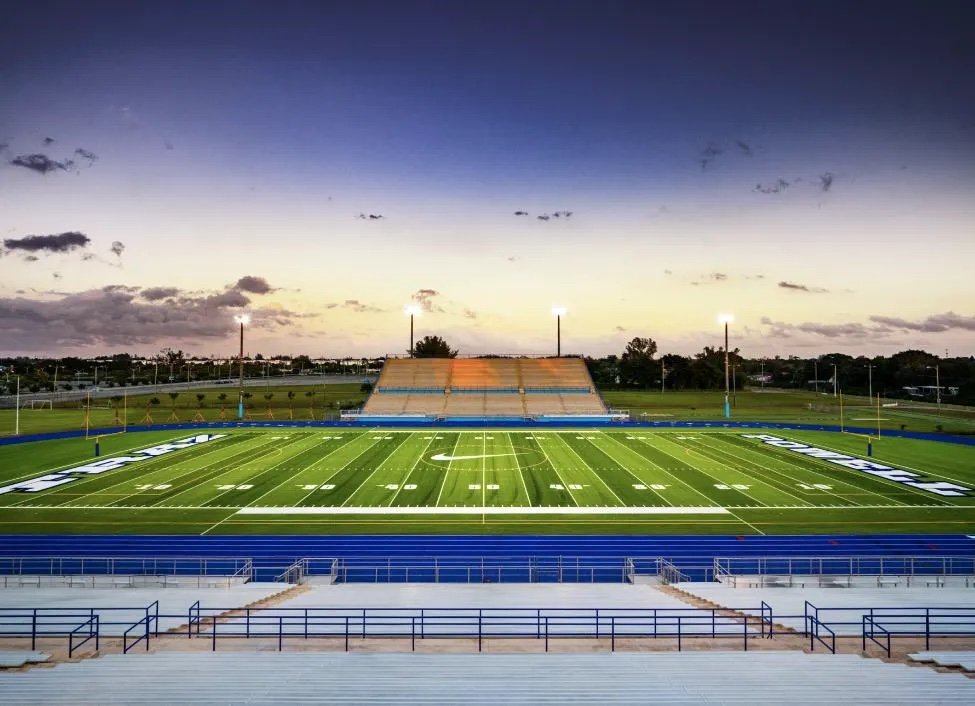
On a Friday night in August, before the heat has broken and while the air still carries the weight of a Florida summer, parking lots outside high school stadiums across the state fill up two hours before kickoff. Tailgates go up. Marching bands run their sets behind the bleachers. In Liberty City. In Tallahassee. In a town of three thousand people near the Georgia border. Whatever the scoreboard says by the final whistle, the crowd will be there for every play.
Florida produces more NFL players per capita than any other state — a pipeline built not in college programs but in these Friday night games, where Division I recruiters sit in visitors' bleachers with clipboards and the margin between a scholarship offer and a missed opportunity is sometimes a single well-lit play. Deion Sanders. Emmitt Smith. Warrick Dunn. Antonio Brown. Their stories began under the lights of stadiums that seat maybe four thousand people, in games that entire communities treat as civic events.
This is not a list of every rivalry in the state. It is a guide to ten games that carry genuine weight — games with history, atmosphere, and cultural significance that extends well past the final score. Some pit powerhouse programs against each other in matchups that have produced more combined state championships than most states have total. Some are small-town affairs where the rivalry predates the coaches, the athletic directors, and most of the families in the stands. What follows skips the recycled listicles and focuses instead on the games worth planning a trip around.
Miami Northwestern vs. Miami Central — The Liberty City Classic
No rivalry in Florida prep football carries more weight in a single zip code. Both schools sit inside Liberty City, and the game between them is less a football contest than a neighborhood referendum. Northwestern has long been one of the most decorated programs in state history, producing NFL talent at a rate that defies its size. Central has matched it in recent decades. The bleachers fill with alumni who graduated twenty years apart, and the marching band performances alone would justify the drive from anywhere in South Florida.
St. Thomas Aquinas vs. American Heritage Plantation
The private school arms race in Broward County reaches its peak when these two programs meet. St. Thomas Aquinas, based in Fort Lauderdale, has been a national program for decades — its alumni list reads like a first-round draft board. American Heritage in Plantation has built a roster with comparable recruiting reach and has pushed Aquinas harder than any program in the region. The game draws scouts from programs across the SEC and Big Ten, and the sideline talent on both teams would embarrass most small college rosters.
Chaminade-Madonna vs. Cardinal Gibbons
Hollywood versus Fort Lauderdale. Two Catholic programs, both with serious football pedigrees, fighting over Broward County supremacy every season. Chaminade-Madonna has used its relatively small enrollment to punch dramatically above its weight class, winning multiple state championships in larger classifications. Cardinal Gibbons brings size and tradition. The game tends to be physical in the way that games between well-coached, well-recruited programs always are — clean execution and contested field position, not chaos. Worth attending for the football alone.
Armwood vs. Plant — Tampa Bay's Defining Game
Hillsborough County is among the most talent-rich football counties in the country, and Armwood and Plant sit at the top of that food chain. Armwood, in Seffner, has a blue-collar identity and a habit of developing linemen and backs who end up at major programs. Plant, in South Tampa, carries a more polished reputation and draws from one of the wealthiest zip codes in the state. When they meet, the contrast in school culture makes the athletic competition feel like something larger. Both programs have the state title hardware to back up the rivalry's billing.
Plant vs. Hillsborough — The Old Tampa Rivalry
Before Tampa's demographic shifts reshuffled attendance zones, the Plant-Hillsborough game was the game on the south side of the city. Hillsborough High is the oldest public high school in Tampa and carries institutional pride to match. Plant has accumulated more recent hardware, but Hillsborough fans will remind you of the school's history at length and without prompting. The game is geographic as much as athletic — two schools separated by a few miles and a significant gap in recent outcomes, which makes the occasional Hillsborough victory land harder than a typical win.
Trinity Christian vs. Bolles — Jacksonville's Private School War
Northeast Florida's version of the Broward private school rivalry plays out between these two Jacksonville programs. Bolles has one of the longest winning traditions in the state and a facilities budget that reflects its tuition. Trinity Christian has matched it in recent cycles, and the two programs have traded state titles and recruiting classes with increasing competitiveness. The game draws a crowd that skews older and more affluent than the typical Friday night audience, but the football is legitimate and the stakes are genuine. Both programs have sent quarterbacks to the NFL.
Lincoln vs. Leon — The Tallahassee City Championship
Florida's capital city is a college football town — Florida State casts a long shadow — but prep football maintains its hold through this intra-city rivalry. Lincoln and Leon play for neighborhood pride in a city where the two schools are separated by a few miles and a significant social history. Lincoln, historically a predominantly Black school, has produced talent that rivals any program in North Florida. Leon has countered with strong coaching and consistent recruiting. The game matters to people who graduated from these schools decades ago, which is the most reliable indicator that a rivalry is real.
Madison County Cowboys — The Small-Town Standard
Madison County, a rural district in North Florida with a population that would fit comfortably inside most Florida high school football stadiums, has won more state championships than programs with ten times its enrollment. The Cowboys are the benchmark for small-town program excellence in the state — their games against rivals from Hamilton County and Jefferson County carry the specific intensity of communities where football is not one of several options but the main event every Friday from August through November. When Madison County loses, it is news well beyond the county line.
Cocoa vs. Rockledge — The Space Coast Showdown
Brevard County has produced a disproportionate share of Florida's NFL talent, and the rivalry between Cocoa and Rockledge sits at the center of that tradition. Cocoa's Tigers have won state titles in multiple classifications and built a reputation for physicality that reflects the program's coaching philosophy. Rockledge pushes back with consistent athleticism and a fan base that treats this game as the annual high-water mark of the local sports calendar. The stadium atmosphere is loud, the talent level is legitimate, and the drive from Orlando takes less than an hour.
Pahokee vs. Belle Glade — The Muck Bowl
The most famous small-town rivalry in Florida prep football, and arguably one of the most talent-rich games played anywhere in the country on a per-capita basis. The two towns sit on opposite ends of Lake Okeechobee, separated by twenty miles of sugar cane fields, and together they have produced a number of NFL players that defies all demographic logic. The Muck Bowl gets its name from the black soil that defines the region's agriculture and economy. The game is community theater in the truest sense — the entire social fabric of both towns reorganizes itself around it. If you go once, you will understand why people drive four hours from Miami to attend.
When to Go
Florida's high school football season runs from August through December, with the state championship games typically held in mid-December in Tallahassee. The early-season games in August and September are played in genuine heat — temperatures routinely sit above ninety degrees at kickoff, and the humidity makes the upper bleachers uncomfortable without water and patience. October and November offer the most pleasant conditions: evening temperatures drop to the mid-seventies across most of the state, and the games carry the added urgency of playoff positioning. Avoid rivalry games without doing some basic research on parking and gate policies in advance, as larger programs often sell out bleacher seating and operate cash-only entry. Treat visiting student sections with the courtesy you would want extended to yours — these games matter deeply to the people who attend them, and the atmosphere rewards respectful engagement.