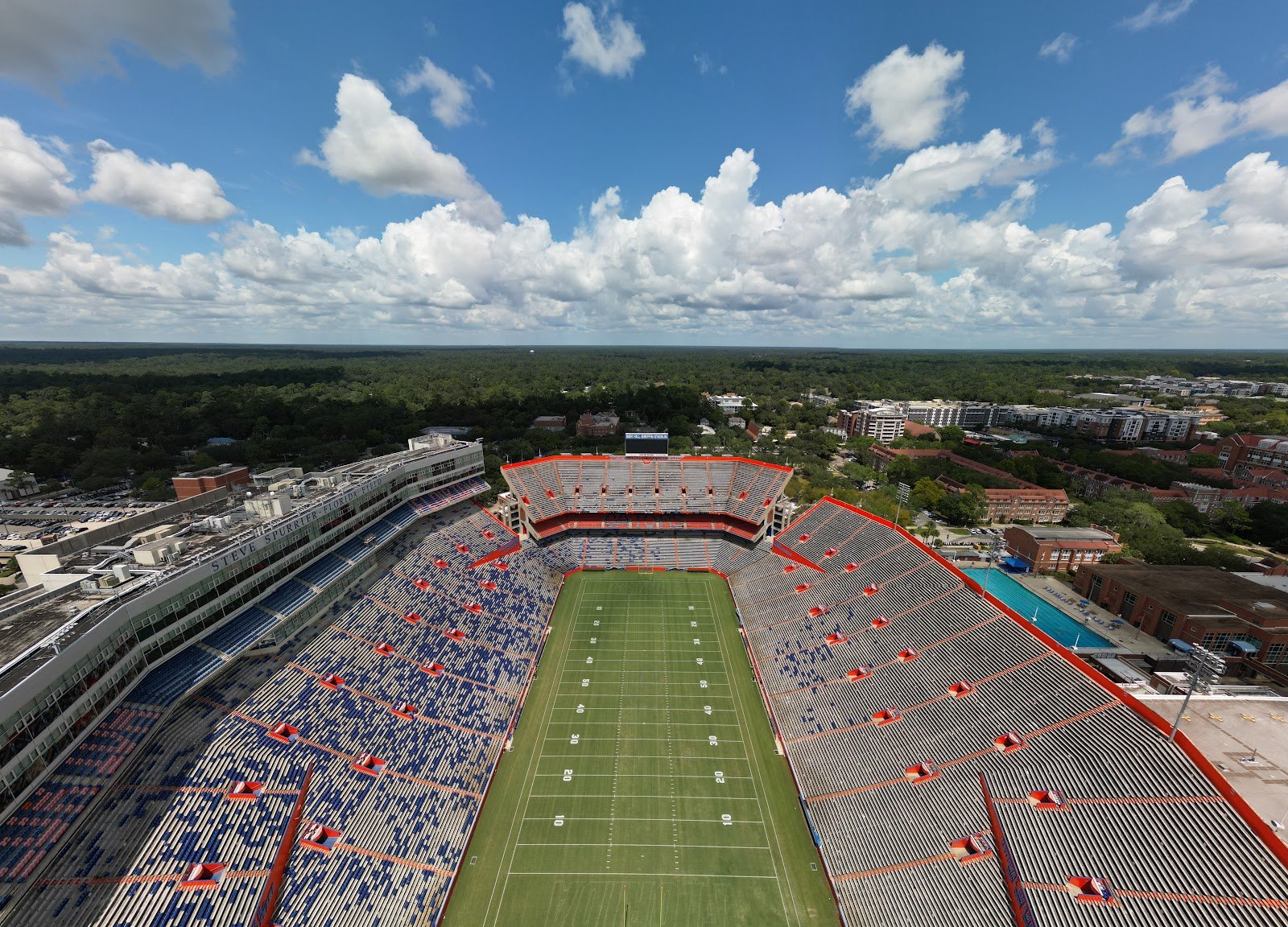
Ben Hill Griffin Stadium holds somewhere north of 88,000 people, but the number that matters more is this: Gainesville's permanent population sits around 140,000. On a home football Saturday, the city swells by more than half again. Traffic backs up on I-75 before most people have finished their coffee. The orange and blue flags go up on Thursday. By Friday evening, the RV lots flanking the stadium are already half-full, generator hum mixing with the smell of whatever someone is smoking on a Weber three campsites over. This is not a casual sports town.
The Swamp — the nickname that every Florida fan will correct you about if you call it anything else — has a reputation that precedes it, and most of it is earned. The open bowl design traps heat and sound in roughly equal measure. A noon kickoff in September can feel like being slowly roasted from the outside in. A night game in October is something else entirely: the energy crackles, the student section loses its collective mind, and the noise level makes conversation genuinely impossible between third-down plays. If you have never been, the gap between watching on television and standing inside it is considerable.
What follows is a practical guide built for people who want to do it right the first time — not a stadium tour, not a vague list of spots near campus, but a game-day playbook covering when to arrive, where to park, which Midtown bars work for which kinds of crowds, what the unwritten rules of The Swamp actually are, and where to eat after the game when every obvious option has a forty-minute wait.
Friday Night: Arrive Before Gainesville Does
The RV lots around Ben Hill Griffin typically open to overnight campers on Friday. Arriving the evening before rather than Saturday morning is one of the simplest moves available to any serious game-day visitor. By Saturday at seven in the morning, premium spots are gone and the lots nearest the stadium are already dense with tents, canopies, and folding chairs arranged with the precision of people who have done this many times. Friday arrival means you choose your location, sleep reasonably well, and wake up already inside the perimeter.
Check the official UF Athletics site for specific lot openings and overnight policies — they vary by game and shift season to season. What does not change is the logic: earlier is better, and walking distance from the stadium is its own reward.
Frat Row on Friday Night
Museum Road and the surrounding fraternity and sorority corridors come alive on Friday evenings before home games. This is loud, young, and not for everyone, but it offers something useful even for older visitors: a clear read on the energy level heading into the weekend. The parties are largely open-air, the music is aggressive, and the crowd is overwhelmingly students. If you are in your mid-twenties or older and prefer a quieter start, note the scene and head toward Midtown instead.
Saturday Morning Tailgate Culture: What You Are Walking Into
The tailgate scene around The Swamp is not a single thing. There are corporate tents with catered barbecue, alumni club setups with televisions and cocktails, and family spots with kids in Gator onesies running between lawn chairs. The unifying element is orange and blue. The unwritten rules are consistent: do not walk through someone's setup without an invitation — go around — and do not arrive at a stranger's tailgate and immediately start eating their food. Offer something, bring something, or wait to be asked.
Space is genuinely scarce. If you are setting up your own tailgate, earlier arrival opens more options. A canopy, a cooler, and a portable speaker will handle most needs. Generator policies vary by lot; check current rules before bringing one.
Salty Dog Saloon: The Loud Pre-Game Option
In Midtown Gainesville, roughly a mile from the stadium, Salty Dog Saloon is the kind of place that does exactly what it says. It is a bar, it is loud, it is full of Gators fans by ten in the morning on game day, and it has enough outdoor space that the crowd does not feel suffocating even when it is at capacity. This is not a place to have a quiet conversation. It is a place to have a beer, feel the pre-game energy rising, and start walking while you can still hear yourself think.
Grog House Bar & Grill: The More Manageable Option
A short distance from the stadium corridor, Grog House occupies a useful middle ground between the chaos of the biggest Midtown bars and the wait times those spots generate on game day. The beer selection skews more considered than most surrounding options, the food is bar-standard but functional, and the crowd tends toward older alumni and regulars who know the place rather than students who turned up because someone sent a group text. Arrive early and you will have no trouble getting a spot.
Cantina 101: Pre-Game Food That Actually Works
Cantina 101 handles the pre-game food problem that most bars in the vicinity fail to solve: the need for actual sustenance before spending four hours in a concrete bowl under Florida sun. The menu runs toward Tex-Mex staples — tacos, burritos, the expected margarita program. It gets busy on game day, service slows, and waits can stretch. The logic for coming here over a stadium concession stand is simple: the food is better and the portions are larger, and you will want both.
Walking to the Stadium: The Route That Saves Time
The most common mistake out-of-town visitors make is underestimating the walk from their tailgate or parking spot to the stadium gates. Fifteen minutes in the shade becomes thirty in a slow-moving crowd in the heat. Leave earlier than seems necessary. The approach from the north side of the stadium is typically less congested than the main south approach in the final thirty minutes before kickoff. Wear shoes that work on both concrete and uneven grass — the lots are not fully paved, and the crowd density makes finding any clear path a negotiation.
What to Know Before You Enter
Ben Hill Griffin Stadium enforces a clear bag policy — one small clear bag per person, with strict size limits enforced at every gate. Bags that do not comply will not be admitted. Sunscreen in a clear container is worth bringing; the sun inside the open bowl hits without mercy, particularly in the south end zones during day games. Noise-canceling earplugs are not a sign of weakness. The decibel level during third downs is genuinely damaging over extended periods, and the stadium makes no apologies for this.
Section 35: The Student Section Stays with You
The student section in the north end zone, anchored around Section 35, is the loudest part of an already loud stadium. Students stand for the entire game — every down, not just key plays — and the density of bodies in that section generates something between a mosh pit and a collective experience during big defensive stops. If you have tickets in or near the student section, plan to stand. Sitting is functionally impossible and will generate the pointed attention of everyone around you. For visitors who want to experience the full sensory weight of a Florida home game, this is the correct section. For anyone who needs a seat, request something further up the bowl.
The Boston Tea Party: The Tradition Nobody Explains
At a specific moment in the game — tied to a scoring play and coordinated by the student section — thousands of small orange juice cartons are thrown onto the field in what has become one of college football's more distinctive rituals. The cartons are sold at concession stands inside the stadium. If you are sitting nearby and notice people around you holding onto small cartons with unusual purposefulness, you are about to witness it. The tradition has survived multiple attempts to discourage it and shows no signs of stopping. Do not throw anything that is not an orange juice carton, and do not attempt to participate from outside the student section. They manage this on their own terms.
The Gator Chomp: Halftime Protocol
The Gator Chomp — arms extended, hands clapping together at the elbow — is performed at volume throughout the game but most collectively at halftime during band performances and during the third-quarter return. If you do not know how to do it before you arrive, you will learn within the first quarter by watching the people around you. The chomp is not optional. Doing it imperfectly is acceptable. Not doing it at all, when 88,000 people around you are doing it, is the surest way to identify yourself as someone who is not from here.
Post-Game: Satchel's Pizza
Satchel's Pizza on the northeast side of Gainesville is the correct answer to the post-game food question for anyone willing to make the short drive or ride. It is, by most serious accounts, among the best pizza in North Florida, operating out of a sprawling property with outdoor seating, a vintage Airstream bar, and the general energy of a place that has been doing its own thing for a long time and intends to continue. The wait after a home game can be substantial. Plan for it, or go later after the crowd thins. It is worth either strategy.
Post-Game: The Top
The Top, a long-running Gainesville bar and restaurant on NW 6th Street, occupies a position in the local landscape not specifically tied to football but absorbs the post-game crowd well. The menu is eclectic in the specific Gainesville way — the kind of place that has been feeding students, faculty, and regulars across multiple decades without becoming either trendy or stale. It gets busy after games but moves people efficiently, and the food is consistently better than you would expect from a place of its age and price range.
Post-Game: Burger Bistro
Burger Bistro is the choice for anyone whose primary need at the end of a football Saturday is a well-constructed burger consumed without ceremony. It does the thing it does with competence and without pretense, and the post-game crowd tends to be hungry and uncomplicated in their needs. Lines form but move. If you have been on your feet in the stadium for four hours and what you want is protein and a table, this resolves that problem efficiently.
When to Go
The best Florida home games for first-time visitors are October and November matchups, when the humidity of early fall has broken and night games become genuinely comfortable. Early-season games in September — particularly noon kickoffs — mean direct sun on concrete for hours, heat index values that push well past 100 degrees, and a physical experience that can overwhelm visitors who are not acclimated. Bring more water than you think you need regardless of when you go. Avoid surface lots far from the stadium for night games if you plan to leave before post-game traffic clears; exits can be gridlocked for ninety minutes or more. If the Gators are playing a major rival — Florida State, Georgia, or a ranked SEC opponent — expect the crowd to be louder, parking worse, and bar lines longer by a significant margin. Plan accordingly, or treat the chaos as part of the experience.