The coral-rock pillars at the entrances to Coral Gables — those rough, oolitic-limestone gateways at Granada, Douglas, and Alhambra — were quarried from the same ground that became the Venetian Pool. George Merrick had them built in the 1920s as part of a master plan that treated city infrastructure as architecture, and a century later they still do the job of telling you that you have left Miami proper and entered something different. Street signs sit at knee height on white-painted concrete blocks. Banyans arch over Coral Way. The municipal code still dictates building colors.
This is the part of greater Miami that was planned before Miami Beach existed as anything more than a mangrove sandbar, and the planning shows. Coral Gables predates the South Beach Art Deco district by more than a decade, and where the Beach went horizontal and pastel, the Gables went vertical, Mediterranean, and beige. The neighborhood reads as a working downtown with a residential heart, which is rarer in South Florida than it should be.
The lay of the land
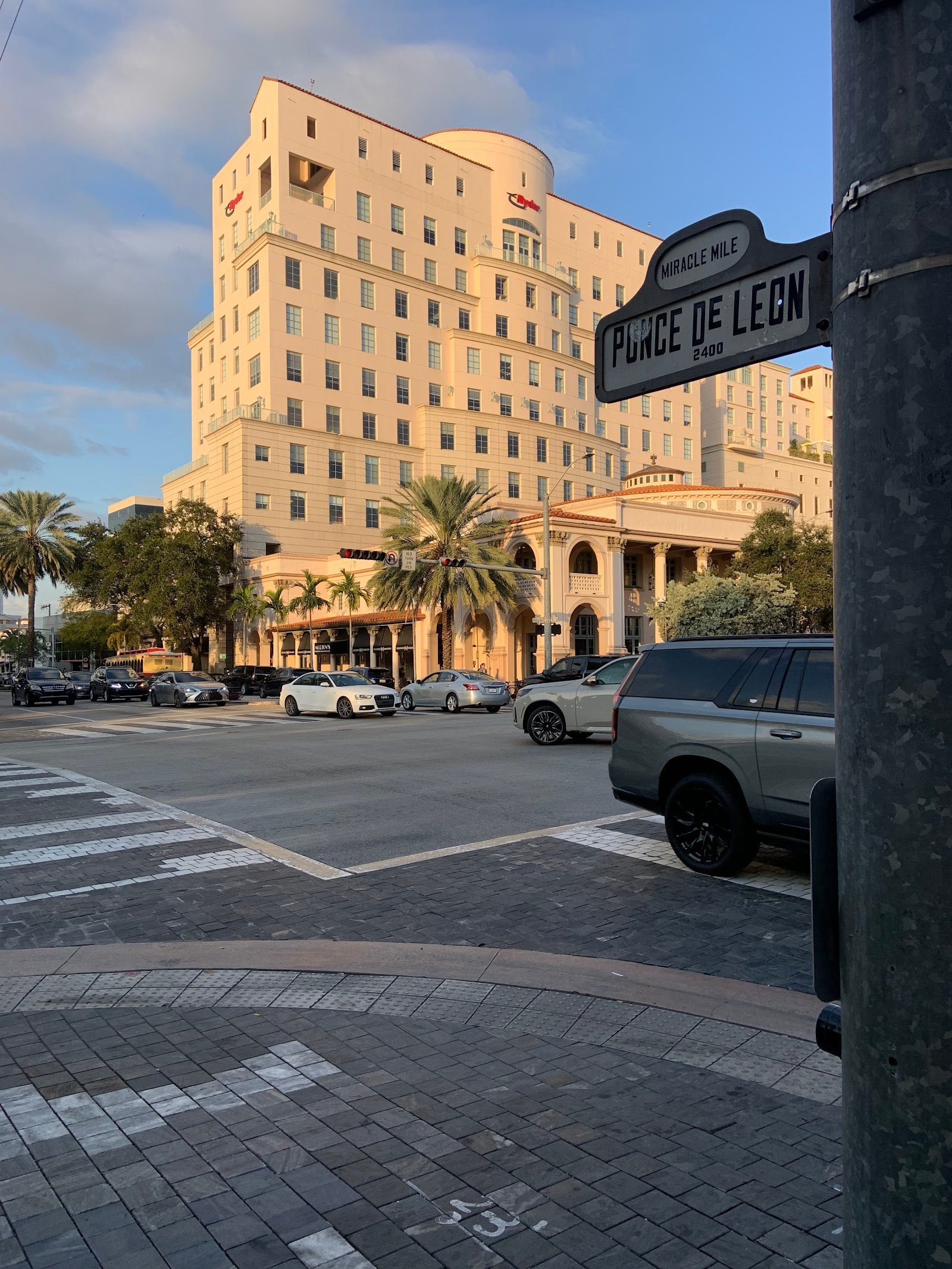
The Gables sits southwest of downtown Miami, bordered roughly by SW 8th Street to the north, Red Road to the west, and the University of Miami campus to the south. The commercial core runs along Miracle Mile — a four-block stretch of Coral Way between Douglas and LeJeune — with Giralda Plaza branching north as a pedestrianized cross-street. Ponce de Leon Boulevard cuts through as the business spine, lined with mid-rise offices and the kind of restaurants that fill up at lunch with people in lanyards.
Merrick founded the city in 1925 as one of the country's first fully planned communities, with strict zoning that dictated Mediterranean Revival architecture and a uniform color palette. The 1926 hurricane and the Depression that followed broke the original development company, but the bones held. What you see today is the slow accretion of a century of compliance with those original rules.
The rough edges are economic rather than physical. Rents on Miracle Mile have pushed out long-running independents, and the recent redesign of the street — wider sidewalks, fewer parking spaces, more landscaping — has been polarizing among the merchants who survived it. The residential streets south of the commercial district remain some of the most expensive real estate in Florida, which is its own kind of tension.
What to do
The Venetian Pool is the anchor and probably the most photographed swimming hole in the state. It was carved from a coral-rock quarry in 1923, fed by artesian wells, and detailed with loggias, bridges, and a faux-Venetian striped mooring pole. It drains and refills daily in the warmer months and operates as a public pool you can actually swim in.
The Biltmore Hotel, finished in 1926, is the other set piece — a 315-foot tower modeled on the Giralda in Seville, with a swimming pool that was the largest in the world when it opened. Walk through the lobby even if you are not staying; the Sunday brunch buffet has the kind of vaulted-ceiling room that explains why this place was once a winter destination for the Vanderbilts.
The Coral Gables Museum, housed in the old police and fire station on Aragon Avenue, runs strong rotating exhibits on local architecture and urban planning. It is small but well-curated, and the building itself — coral rock, arched bays — is worth the visit on its own.
For green space, Matheson Hammock Park on the bay has the atoll-shaped tidal pool and a marina with mangroves, and Fairchild Tropical Botanic Garden next door is one of the best botanic gardens in the country for tropical species. Both are a ten-minute drive south of the commercial core.
For architecture without an admission fee, drive or bike Coral Way west of the city, where the original 1920s villages — the Dutch South African, the French Normandy, the Chinese — sit as themed enclaves Merrick commissioned as marketing stunts that aged into genuine curiosities.
Where to eat and drink
The food scene clusters on three distinct stretches. Miracle Mile and Giralda Plaza hold the sit-down restaurants — the white-tablecloth Spanish, Italian, and Peruvian rooms that draw the lunch crowd from the surrounding offices and the date-night crowd on weekends. Giralda is the better walk: it is closed to cars, the sidewalk tables actually function as sidewalk tables, and the lighting is good after dark.
The Ponce de Leon corridor, particularly the blocks between Andalusia and Valencia, has the newer-wave openings — chef-driven rooms, natural wine bars, and a couple of the better cocktail programs in the broader Miami area. This is where you go when you have outgrown Miracle Mile.
For coffee and casual lunch, the Alhambra Plaza area near the Colonnade Building has the third-wave roasters and the cafes that locals actually work from. For late-night drinks, the bars cluster on the south end of Ponce closer to the University, where the crowd skews younger and the rooms stay open later than the rest of the Gables. Sunday and Monday closures are common, so check before you go.
How to get there
The Metrorail Douglas Road station sits on the eastern edge of the neighborhood, which puts you a fifteen-minute walk from Miracle Mile. The free Coral Gables Trolley runs north-south on Ponce de Leon from 6:30 a.m. to 8 p.m. on weekdays and Saturdays — it is the easiest way to move between the Biltmore area and the commercial core without a car.
Driving in is straightforward; parking is the friction. The city-run garages on Andalusia and Salzedo are the reliable bet. Metered street parking on Miracle Mile and Giralda is enforced aggressively by license-plate-reading cars, and the meters take credit cards or the ParkMobile app. Ride-share works fine but adds twenty minutes if you are coming from the Beach during rush hour.
When to go
Weekday lunches, particularly Tuesday through Thursday, are when the neighborhood feels most like itself — the offices fill the restaurants, the trolley actually has riders, and the Mile has the foot traffic it was redesigned for. Saturday evenings on Giralda Plaza are the best dinner setting in the Gables, with the cars closed off and the restaurants spilling onto the pavement.
The monthly Coral Gables Gallery Night, on first Fridays, opens the small museums and galleries along Ponce and Aragon late into the evening and is the easiest way to see the neighborhood's quieter institutions in one stretch. Avoid August and September weekday afternoons unless you have a clear plan to be indoors; the heat is unserious about pacing itself.
If it's your first time
Park in the Andalusia garage, walk one block south to Giralda Plaza for lunch, then continue west on Coral Way to the Venetian Pool for an hour in the water. Loop back via Granada Boulevard to see the coral-rock entrance and the residential streets in between. That is the Gables in two hours, and it covers the architecture, the water, and the food without backtracking.